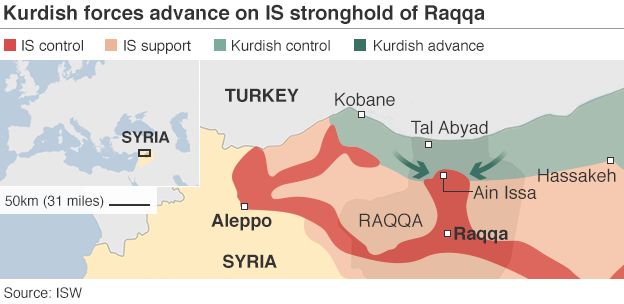
Kurdish fighters in northern Syria say they have captured a key town from Islamic State, just 50km (30 miles) from the group's headquarters at Raqqa.
A spokesman for the the Popular Protection Units (YPG) said Ain Issa and its surrounding villages were now under the militia's "total control".
It follows the capture on Monday night of a military base outside the town.
The YPG captured the town of Tal Abyad on the Turkish border last week, cutting a major supply line for IS.
The jihadist group has suffered a string of defeats to Kurdish forces since being forced to withdraw from the town of Kobane in January after a four-month battle. IS defences 'pushed back'
The Kurds' rapid advance through Raqqa province continued on Monday with the fall of Brigade 93, a base which IS captured from the Syrian military last year. The Syrian Observatory for Human Rights, a UK-based monitoring group, reported that the YPG and allied Syrian rebel fighters overran the base before heading south towards Ain Issa, supported by US-led coalition air strikes.
By Tuesday afternoon, they had taken full control of the town and nearby villages, YPG spokesman Redur Xelil told the Reuters news agency.
"Islamic State's defensive lines have now been pushed back to the outskirts of Raqqa city because the area between Raqqa and Ain Issa is militarily weak and they have no fortifications," Rami Abdul Rahman, the Syrian Observatory's director, told the AFP news agency. ....
Raqqa is the claimed capital of the caliphate claimed by ISIL. There are apparently no fortified positions between Tal Abyad and Raqqa. ISIL may be forced to pull back fighters from Mosul and Ramadi in Iraq to protect their hold on Raqqa in Syria. If Raqqa falls it would be a serious blow to ISIL propaganda and claims of a caliphate.
DailyWire: Harmeet K. Dhillon, founder of the Dhillon Law Group Inc., blasted Democrats’ claims of race-based voter suppression while pointing out the real threat to U.S. election integrity: the federalization of election law. Dhillon and her law firm are representing The Daily Wire in its legal challenge against the Biden administration’s order mandating that large employers either vaccinate or mask and COVID-19 test all their employees. The Supreme Court stayed the order on January 13 in a major blow to the government. Roughly two weeks later, the Occupational Safety and Health Administration withdrew the rule to reassess its implementation. Dhillon is set to appear on “The Ben Shapiro: Sunday Special” episode airing Sunday, January 30. During the episode, Dhillon and host Ben Shapiro cover topics from the Supreme Court’s recent decision to stay President Joe Biden’s vaccine order for large employers and conservatives’ reluctance to engage in “lawfare” with Democrats. When th...
A global war on insurgency Roxanna Tiron: The anti-insurgency tactics the U.S. military is learning in Iraq could be applied globally, which would turn the war on terrorism into a “war on insurgency,” said Lt. Gen. William Boykin, deputy undersecretary of defense for intelligence and war fighting support. “My position is that this is a global insurgency,” said Boykin during a forum on special operations and low intensity conflict. In Iraq and other trouble spots, the United States has to come to grips with the nature of the enemy, he explained. “It is a web of networks that come together in a coalition of convenience. There are links to drug trafficking, money laundering and the like,” he said. An insurgency is a political-military activity, in which the political aspects are much more ...
Gregg Roman: ... Although administration officials have been reluctant to explain the precise reasoning behind their last-minute series of attacks on Israel, as near as I can tell it rests on three assumptions. The first, as Kerry outlined in his speech, is that a freeze on Israeli settlement growth makes it easier for Palestinian negotiators to make painful compromises at the negotiating table. It supposedly does this by easing Palestinian suspicions that Israel either won't make major territorial concessions at the negotiating table, or won't implement these concessions once made. Israeli Prime Minister Benjamin Netanyahu put this assumption to the test in November 2009 when he imposed a 10-month moratorium on new housing construction (East Jerusalem excepted) at the urging of the Obama administration. What happened? Palestinian Authority President Mahmoud Abbas refused to return to talks until the very end of the moratorium and remained every bit as intransigent as ...
Comments
Post a Comment