Christmas 1862
James Robbins:
By 1862 the Civil War had set in with all its grimness. The year saw a series of major battles that would long be remembered; the Seven Days Battles, Shiloh, Second Manassas, and Antietam, the bloodiest single day of the war. And while thousands had died in combat, and many more of disease, the conflict was not measurably closer to its conclusion.He goes on to point out that it was not any happier for Jefferson Davis. There is much more in this interesting snapshot of history. The battle of Fredericksburg points out how the machinery of warfare had outrun the old tactics. Dug in men with rifles could defeat charging troops and cavalry. It would be like that until the tank was invented in World War I and airplanes were added to the attack elements. Still not even the Confederate military learned that lesson as they had to learn it again with Pickett's charge at Gettysburg. Decades later, the British had to relearn the lesson with the disastrous charge of the Light Brigade in the Crimean War. In World War I it took bloody battles like the Somme to relearn the lessons of Fredericksburg.
But as in 1861, the spirit of the season was evident that winter. The New York Times reported that Christmas 1862 was “the dampest, warmest, muggiest and most burdened with mingled feelings of joy and grief.” The unseasonably warm weather had made the Central Park Pond unsafe for skating, but had brought out crowds of Christmas shoppers. “The money expended this year in Christmas gifts exceeds by far, by very far, that which has gone that way in many years,” the Times noted. Furs were a popular gift that year, and the streets echoed with the blare of tin horns, the latest craze among young boys.
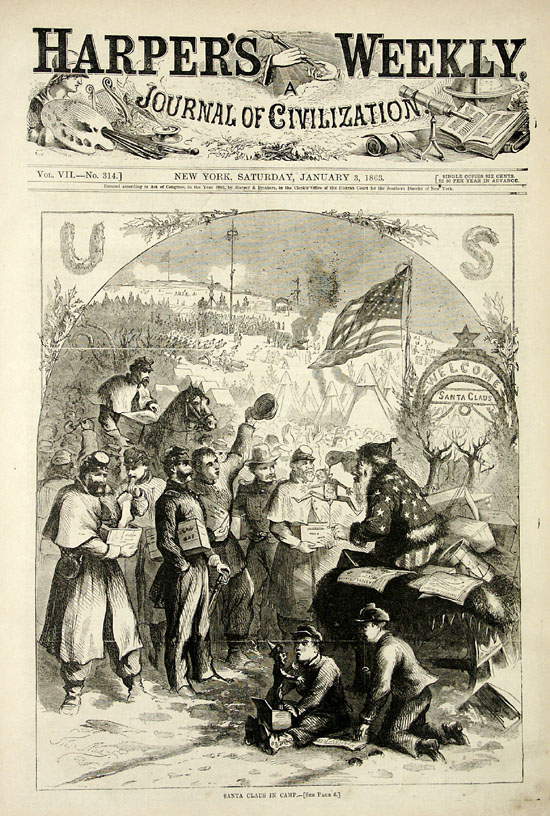
The 1862 season saw an important cultural milestone, the emergence of the modern image of Santa Claus. Famed illustrator FOC Darley published an edition of Clement Clark Moore’s A Visit from St. Nicholas (‘Twas the Night Before Christmas) featuring drawings of Santa as a plump man with a pipe, furry coat and pointed hat. Thomas Nast, who in the late 19th century produced what came to be regarded as the definitive representations of St. Nick, published his first Santa drawing in Harper’s Weekly, January 3, 1863. “Santa Claus in Camp“ showed a star-spangled Santa in his reindeer-drawn sleigh handing out presents to jubilant soldiers. In the background, troops engaged in various games, climbing a greased pole, chasing a greased boar, playing football. Sports were a part of the festivities at many encampments. A reported 40,000 soldiers watched a baseball game at Hilton Head, S.C., between the 165th New York Zouave regiment and a picked team from other units. One of the players was Abraham Gilbert Mills, later president of the National League.
The mood in Washington was gloomy. It had been ten days since the conclusion of the Battle of Fredericksburg, Ambrose Burnside’s futile assault against strongly emplaced Confederate defenders. There were 12,600 Union casualties, many of whom were transported to the 46 hospitals in the Washington area. President Lincoln was visibly shaken by the outcome of the battle, and looked more sad and careworn than usual. He remarked to his friend Governor Andrew G. Curtin of Pennsylvania, “If there is a worse place than Hell, I am in it.” Lincoln visited several of the local hospitals and spoke with many of the patients. 6,000 pounds of poultry and “large quantities of other delicacies” were distributed to the hospitals for the Christmas dinners of the wounded. “Fish, flesh and fowl, puddings and pies, and these of all sorts,” one report said, “with plenty of cider.”
...

Comments
Post a Comment