Iran's rat lines into Iraq
Bill Roggio:
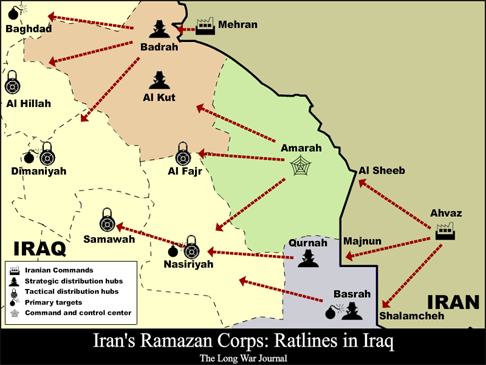
It is hard to read this report and not think how ignorant the criticism of Hillary Clinton's vote on the declaration of the Qods Force as a terrorist organization. It is also clear that Edwards and Obama's position on Iran is at best naive and willfully ignorant. Their objection to the resolution on the Qods force is reason along for people to conclude that they are too ignorant of national security to be considered for high office. The report is worth reading in full. Roggio also provides a graphic of the rat lines.
The issue of Iranian complicity in the Iraqi insurgency has been contentious since US and Iraqi forces began heavily targeting the Iranian networks in late 2006. While news reports have touted Iran's role in reducing the violence, US military officers believe Iran still serves as a source of weapons and fighters in Iraq.There is much more.
The Long War Journal has spoken to several mid-level and senior US military and intelligence officers, all of whom have declined to go on the record due to the sensitive nature of the Iranian issue. Based on these conversations as well as other information, The Long War Journal has learned the nature of the Qods Force operations in Iraq and how they move resources into the country.
Iran began to extend its influence in Iraq immediately after the fall of Saddam Hussein's regime in April 2003. Through the Qods Force, Iran's external wing of the Revolutionary Guards Corps, Iran immediately moved money, weapons, and operatives inside Iraq to influence the various fractured Shia political parties and militias.
Iran worked through various militias such as the Mahdi Army, the Badr Corps, the Qazali Network, the Shebaini Network, and a host of other surrogates to attack Coalition forces, Iraqi Security Forces, and rival political leaders. When groups like the Badr Corps and its political backer the Supreme Council for Islamic Revolution in Iraq broke from the Iranian sphere of influence and integrated with the government, the Iranian-backed militias, which have since been designated the Special Groups, began attacking them as well.
To streamline operations in Iraq, the Qods Force established a unified command, called the Ramazan Corps, and split Iraq into three roughly geographical regions.
The picture of Qods Force's command structure and operations in Iraq became clearer since US forces began heavily targeting the Iranian networks in late December 2006. Several high-level Qods Force officers – including Qais Qazali, Azhar al Dulaimi, Ali Mussa Daqduq, and Mahmud Farhadi – have been captured in Irbil, Baghdad, and several unnamed locations.
During these raids, Coalition forces seized computers and computer drives, documentation, journals, and other evidence that reinforced information obtained through the interrogations of the Qods Force officers. While military and intelligence sources would not discuss other methods, communications intercepts and satellite imagery are also likely to play a key role in understanding the Qods Force's activities in Iraq.
Critical information about the structure of the Ramazan Corps comes from the Iranian operatives captured in Iraq....
...
It is hard to read this report and not think how ignorant the criticism of Hillary Clinton's vote on the declaration of the Qods Force as a terrorist organization. It is also clear that Edwards and Obama's position on Iran is at best naive and willfully ignorant. Their objection to the resolution on the Qods force is reason along for people to conclude that they are too ignorant of national security to be considered for high office. The report is worth reading in full. Roggio also provides a graphic of the rat lines.
Comments
Post a Comment